

Taking Center Stage — Jesus Christ: The Preeminent One


“He is the beginning and firstborn from among the dead, so that in all things He might have the preeminence.” Colossians 1:18

Overture – From Stage to Symphony
Throughout this Advent season, I’ve been thinking about Christmas in terms of a great unfolding drama—many characters stepping onto the stage at just the right moment, each with an important role to play.
I started out with Characters of the Nativity:
Zechariah and Elizabeth
Simeon and Anna
Mary and Joseph
Then, I moved on to introduce more of the Christmas Players:
The shepherds and the angels
The Magi
King Herod
The star itself
These all set the stage, if you will, for the grand entrance of the One and Only
“Leading Man.”

But today, I feel the metaphor shifting just a bit. What comes to my imagination now feels less like a stage play to me than it does a symphony. One great, unified, intricate, beautiful musical work composed by God Himself, unfolding across time, history, and eternity. There are many movements, many themes, many instruments—but one Central Figure to whom the entire work belongs:
Jesus Christ

So, today, instead of picking up our shovels,
let’s lift our batons!
🎻Movement I – The First Theme Is Introduced (Genesis & the Law)
The promise is sounded—

The story of Jesus Christ does not begin in Bethlehem. It begins almost immediately after the fall (note - the Son of God existed in eternity past; His designation as “Jesus Christ” - the Messiah - is in response to the new need of a Savior):

As part of God's judgement of Satan after Eve and then Adam were deceived by Him into eating the forbidden fruit:
“I will put enmity between you and the woman,
and between your seed and her Seed;
He shall bruise your head,
and you shall bruise His heel.”
(Genesis 3:15)
At the same time judgement is being imposed, redemption is being promised! The Seed is Jesus Christ; the One who will be wounded, yes, but ultimately He will be victorious over Satan and over death.

As Scripture unfolds, the theme continues as God speaks to Abraham:
“In you all the families of the earth shall be blessed.”(Genesis 12:3)

Then to Moses:
“The LORD your God will raise up for you a Prophet like me from your midst… Him you shall hear.”(Deuteronomy 18:15)

At the Passover, as Moses is about to lead the Hebrews out of Egypt, the melody becomes unmistakably sacrificial:
“Now the blood shall be a sign for you… and when I see the blood, I will pass over you.”(Exodus 12:13)
A clear foreshadowing of the coming sacrifice of Jesus Christ – the spotless Lamb of God,
"...Who taketh away the sin of the world."
Movement II – The Theme Grows Richer (Psalms, Wisdom, Prophets)
The music deepens, as suffering and glory begin to meld.

The Psalms occupy a unique place in this unfolding symphony, functioning not only as prayers and songs of worship, but as profoundly Messianic declarations. Though many psalms arise from the lived experiences of David and other writers, the Spirit carries their words far beyond their immediate circumstances. Again and again, the voice shifts—sometimes subtly, sometimes unmistakably—from the psalmist to the coming King Himself. This is one of the uncanny things about God throughout the scriptures - talking about one thing but actually meaning two (or more) things at the same time! There are several Psalms that are called "Messianic Psalms." The Psalms speak of a Son begotten by God, a Lord seated at His right hand, a righteous sufferer whose hands and feet are pierced, whose garments are divided, and yet whose reign is eternal. In these songs, suffering and glory are woven together long before their meaning is fully revealed.
Israel sang these truths for centuries, often without realizing they were rehearsing the life, death, resurrection, and exaltation of Jesus Christ.

The Father speaks to the Son:
“You are My Son,
Today I have begotten You.”
(Psalm 2:7)
“The LORD said to my Lord,
‘Sit at My right hand,
Till I make Your enemies Your footstool.’”
(Psalm 110:1)
And yet this same King suffers:
“They pierced My hands and My feet…
They divide My garments among them.”(Psalm 22:16–18)
Wisdom itself seems to speak of a Presence before creation:

“The LORD possessed me at the beginning of His way…
Before the depths I was brought forth.”(Proverbs 8:22–24)

The Prophets then bring astonishing clarity:
“Behold, the virgin shall conceive and bear a Son,
and shall call His name Immanuel.”
(Isaiah 7:14)

“For unto us a Child is born…
And the government will be upon His shoulder.”
(Isaiah 9:6–7)
“He was wounded for our transgressions…
and the LORD has laid on Him
the iniquity of us all.”
(Isaiah 53:5–6)
“But thou, Bethlehem Ephratah,
though thou be little among the thousands of Judah,
yet out of thee shall He come forth unto Me
that is to be ruler in Israel;
whose goings forth have been from of old,
from everlasting.”
(Micah 5:2)
Centuries ahead the Father is preparing the world to recognize His Son when He takes center stage in Bethlehem! 😱
🎻Movement III – Glimpses of the Coming One (Christophanies)
The Composer briefly steps into - and then out - of His own music on the earth!

At key moments throughout the Old Testament, scattered here and there, a mysterious figure appears—usually called the Angel of the LORD—yet speaking as God and receiving worship. This is one of the really fascinating things I observe in the Bible! It demonstrates that Jesus Christ is always “right there,” we just can’t see Him. So at various times and places, He pops up in what is called a “preincarnate appearance” – i.e., the Son of God interacting visibly/audibly with humans.
Some examples:
The Angel of the LORD appears to Hagar, Sarah’s servant, the mother of Ishmael, as she is desperate and running away, and she says of Him:
“You are the God who sees,”(Genesis 16:13)
To Moses, the Angel of the LORD says:
“I am the God of your father—
the God of Abraham,
the God of Isaac, and the God of Jacob.”
(Exodus 3:6)

And when Joshua encounters a warrior with a drawn sword:
“No; but as Commander of the army of the LORD
I have now come.”
(Joshua 5:14)
And Joshua fell on his face to the earth and worshiped, which he would only do if he recognized the Commander was God Himself.
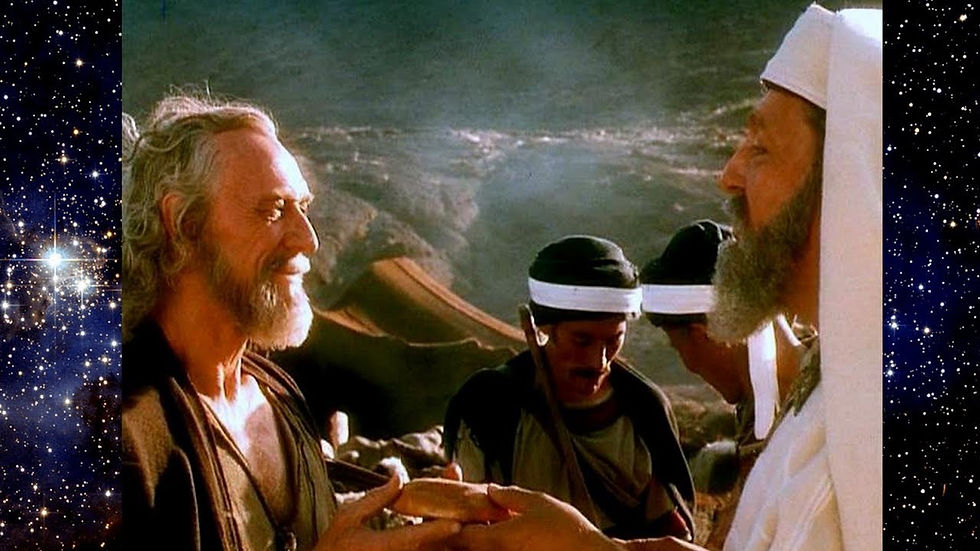
These appearances are foreshadowing—glimpses of the One who will later come fully in the flesh. My favorite? Melchizedek, king of Salem and priest of God Most High, appears briefly in Genesis 14 without genealogy and uniquely functions as both king and priest—roles later kept separate under the Law.
Unlike other preincarnate appearances of the Son of God, he is not called “the Angel of the LORD,” yet he blesses Abraham and then simply disappears from the narrative -POOF! 💥
Scripture later returns to this moment (Psalm 110; Hebrews 7) to show that Melchizedek points to an eternal priesthood ultimately fulfilled in none other than:
JESUS CHRIST
🎹Movement IV – The Theme Revealed in Full (The Gospels)
The Word becomes flesh.

John couldn’t say it more plainly:
“In the beginning was the Word…
And the Word was God.”
(John 1:1)
“And the Word became flesh and dwelt among us,
and we beheld His glory.”(John 1:14)
At His birth, the angels announce:
“For there is born to you this day…
a Savior, who is Christ the Lord.”
(Luke 2:11)
He begins to reveal Himself to individuals as He walks the earth:
Even though, when Jesus Christ arrived on earth the first time, His arrival was couched in humility, the writers of the gospels – His disciples - gradually became keenly aware of Who He actually was.
“When Jesus came into the region of Caesarea Philippi, He asked His disciples, saying, ‘Who do men say that I, the Son of Man, am?’
So they said, ‘Some say John the Baptist, some Elijah, and others Jeremiah or one of the prophets.’
He said to them, ‘But who do you say that I am?’
Simon Peter answered and said, ‘
You are the Christ, the Son of the living God.’”
(Matthew 16:13–16)

It is Jesus, however, Who gives the greatest insight into His relationship as God the Son with God the Father when He prays, just before He goes to the cross:
"Jesus spoke these things; and lifting up His eyes to heaven, He said,
'Father, the hour has come;
glorify Your Son, that the Son may glorify You,
even as You gave Him authority over all flesh,
that to all whom You have given Him,
He may give eternal life.
And this is life eternal, that they may know You,
the only true God,
and Jesus Christ whom You have sent.
I glorified You on the earth,
having accomplished the work
which You have given Me to do.
Now, Father, glorify Me together with Yourself,
with the glory which I had with You
before the world was.'"
- John 17:1-5
🎺Movement V – God Continues to Speak through the Apostles (The Epistles)
The meaning of history is made abundantly clear.

This passage is astounding in its clear explanation of "it all!"
"Giving thanks to the Father,
which has made us meet to be partakers
of the inheritance of the saints in light;
Who has delivered us from the power of darkness,
and has translated us into the kingdom of His dear Son,
In whom we have redemption through His blood,
even the forgiveness of sins:
Who is the image of the invisible God,
the firstborn of every creature:
For by Him were all things created,
that are in heaven, and that are in earth,
visible and invisible,
whether they be thrones, or dominions,
or principalities, or powers:
all things were created by Him, and for Him:
And He is before all things,
and by Him all things consist.
And He is the head of the body, the church:
who is the beginning, the firstborn from the dead;
that in all things He might have the preeminence."
(Colossians 1:12–18)

Here, the word translated preeminence comes from the Greek verb:
πρωτεύω (prōteuō)
to be first
to hold first place
to have supremacy or chief rank

In Paul’s letter to the Philippians, he explains - in no uncertain terms - that the Father’s full intention is to bring glory to the Son:
“Therefore God also has highly exalted Him
and given Him the name which is above every name,
that at the name of Jesus every knee should bow…
and every tongue confess that Jesus Christ is Lord,
to the glory of God the Father.”
(Philippians 2:9–11)
Jesus Christ - the Preeminent One.
🥁Final Movement – Glory Revealed (Revelation)
The symphony resolves in triumph!

The baby born in humility returns as King:
“Now I saw heaven opened, and behold, a white horse.
And He who sat on him was called Faithful and True…
And He has on His robe and on His thigh a name written:
KING OF KINGS AND LORD OF LORDS.”
(Revelation 19:11, 16)
And the final message of Scripture echoes the first:

“I am the Alpha and the Omega, the Beginning and the End
the First and the Last.”
(Revelation 22:13)
🎼Coda – The Final Note

From before creation…through promise, prophecy, presence, incarnation, exaltation…and into eternity yet to come—
This is not merely the story of Christmas.
It is the story of everything: Jesus Christ IS everything.
“That He might in all things have the preeminence.”
I can think of no more fitting closing music than Handel's entire Messiah...
When George Frideric Handel composed Messiah in 1741, he did so under circumstances that feel less like ordinary artistic productivity and more like divine compulsion. The entire score was completed in a staggering twenty-four days, an almost unheard-of feat for a work of such theological depth, musical complexity, and sheer scope.

Handel worked with such intensity that he reportedly barely slept, and when he finished the great “Hallelujah Chorus,” he is said to have wept, declaring that he believed he had seen heaven opened before him. The libretto, drawn directly from Scripture and compiled by Charles Jennens, does not dramatize events with characters or stage action, but allows the Word of God itself to speak — prophecy, incarnation, suffering, resurrection, and final exaltation unfolding in musical form. In this way, Messiah stands not merely as a human composition, but as a testimony to how God, at times, lays hold of a willing vessel and pours forth something far greater than the vessel alone could ever produce — a symphonic proclamation that Jesus Christ is, indeed, the Preeminent One.


Comments