

Christmas Players – The Star That Spoke Without Words


This Advent season I am curiously drawn into fascination with various aspects of the Christmas Story as told in Scripture. The wonders of our LORD just never end, and – like so much in learning – the more you know the more you know you don’t know!
Earlier in this Advent series I took a deeper look into Zechariah & Elizabeth, Joseph & Mary, Anna & Simeon. Now I would like to look into some of the other “Christmas Players,” starting today with THE STAR that led the wisemen to Jesus. Tomorrow, we’ll take a good long look at them. They are perhaps one of the most mysterious and underrecognized characters in this eternally epic nonfiction.
Polish up your shovel, and let’s start digging!

What are stars, anyway?
From a basic scientific standpoint, a star is an enormous, burning sphere—so massive and energetic it’s almost beyond comprehension. Stars are made of blazing gases (and plasma), with hydrogen as the primary “fuel,” and in their depths they produce tremendous energy. They shine. They burn. They hold together by forces we can describe, but not truly tame.

A Few Astonishing Facts About Stars
How many stars are there?
Scientists estimate there are hundreds of billions of stars in our Milky Way galaxy alone, and hundreds of billions of galaxies in the observable universe. Altogether, this leads to estimates of 10²²–10²⁴ stars — more stars than grains of sand on all the beaches of the earth.
How long does a star last?
A star’s lifespan depends on its size.
Small stars burn slowly and are thought to last extremely long periods of time.
Sun-sized stars are estimated to shine for about 10 billion years.
Large stars burn intensely and live much shorter lives, sometimes only millions of years, often ending in dramatic explosions.
How long does starlight take to reach us?
- Light from the sun reaches Earth in about 8 minutes.
- Light from the nearest star beyond the sun takes just over 4 years to reach us.
- Light from more distant stars and galaxies can take thousands to millions of years to arrive.
Where do They Come From?
Scripture tells us the stars are created things, purposely placed, appointed, and governed.
“In the beginning God created the heaven and the earth.”
(Genesis 1:1)
“By the word of the LORD were the heavens made;
and all the host of them by the breath of his mouth.”
(Psalm 33:6)
When were stars created?
Scripture is plain: the lights of the heavens were appointed on the fourth day of creation week:
“And God said, Let there be lights
in the firmament of the heaven
to divide the day from the night;
and let them be for signs, and for seasons,
and for days, and years.”
(Genesis 1:14)
“And God set them in the firmament of the heaven
to give light upon the earth.”
(Genesis 1:17)
“And God made two great lights… he made the stars also.”
(Genesis 1:16)
I love how it says “He made the stars, also…” Like, “ho, hum… oh yeah, see those amazing lights in the sky, yeah, He made those, too…” Well, you have to admit, for God it’s like striking a match! 🥢☺️
And notice their purpose: they were made for order and meaning—“for signs, and for seasons.” They mark time. They testify. They serve.

What does Scripture emphasize about stars?
The Bible talks about stars a lot. Scripture speaks of them as a numbered host, under command, sustained by God’s power and care.
“He telleth the number of the stars; he calleth them all by their names.” (Psalm 147:4)
That is astounding and breathtaking. It makes me feel very confident as His child. If He calls every star by name – the, “oh yeah, he also made the stars…” – He certainly knows my name; if He can tell the number of the stars, He certainly knows the number of my years. Phew! 😮💨
Isaiah presses the point even further:
“Lift up your eyes on high,
and behold who hath created these things,
that bringeth out their host by number:
He calleth them all by names… not one faileth.”
(Isaiah 40:26)
Not one missing. Not one misplaced. Not one forgotten.

And the stars do something silently, constantly:
“The heavens declare the glory of God; and the firmament sheweth his handywork.” (Psalm 19:1)
“There is no speech nor language, where their voice is not heard.” (Psalm 19:3)
They preach without words.

“Star” in Scripture: more than one meaning
Now here is where our digging gets especially interesting. In Scripture, the term star is sometimes used not only for heavenly lights, but as imagery for heavenly beings—messengers, servants, and in some cases, fallen powers.
In Job, God describes the joy of creation using language that links “stars” with angelic beings:
“When the morning stars sang together,
and all the sons of God shouted for joy?”
(Job 38:7)
That is no small line! It gives us a glimpse: creation was not quiet. Heaven rejoiced!

Scripture also uses “star” imagery for a fallen figure:
“How art thou fallen from heaven, O Lucifer, son of the morning!”
(Isaiah 14:12)
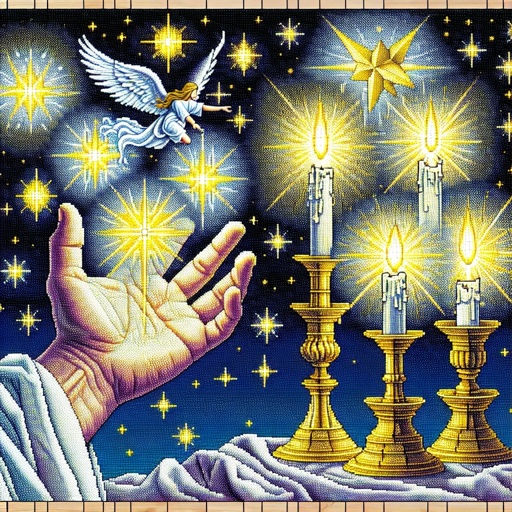
And in Revelation, “stars” can symbolically represent angelic messengers:
“The seven stars are the angels of the seven churches.”
(Revelation 1:20)
This doesn’t mean every mention of a star is an angel. But it does mean the biblical imagination is richer than ours. The heavens are not merely physical; Scripture hints that there is spiritual meaning woven into the story of light and darkness. Which makes this next truth even more stunning!

Jesus: the Bright and Morning Star
The Bible does not merely say stars are made by God. It goes further: Jesus identifies Himself with star imagery.
“I am the root and the offspring of David, and the bright and morning star.” (Revelation 22:16)
The “morning star” is seen while it is still dark—but it signals that dawn is near. It is a promise in the night. A herald of daybreak.
And then… the Christmas Star

Now we come to the star that appears in Matthew’s account.
“Now when Jesus was born in Bethlehem of Judaea
in the days of Herod the king,
behold, there came wise men from the east to Jerusalem,
Saying, Where is he that is born King of the Jews?
for we have seen his star in the east,
and are come to worship him.”
(Matthew 2:1–2)
First, note what they call it: “His star.”
This is not just any star or even an amazing extraordinary star, this is HIS star, and the wisemen somehow knew that.
Second, notice what this star does:
“When they had heard the king, they departed;
and, lo, the star, which they saw in the east,
went before them, till it came and stood over
where the young child was.”
(Matthew 2:9)
It “went before them.” It “stood over” the place.
However we understand the mechanics, this star is not behaving like a normal distant object. It is guiding—like a lamp for travelers.

And when they see it again:
“When they saw the star,
they rejoiced with exceeding great joy.”
(Matthew 2:10)
What might it have been?

Over the years, thoughtful minds have proposed possibilities:
a rare conjunction of bright planets
an unusual astronomical event such as a nova
a comet-like phenomenon
or something entirely supernatural: a divinely appointed light, guided in a way no ordinary star behaves
I don’t think Matthew’s goal is to satisfy our charts and calculations. His goal is to declare that God gave a sign that would be seen, recognized, and followed by seekers from afar—and that this sign led them to the Christ.
Genesis told us the lights were made “for signs.” Here, in Matthew, we see God using that very purpose at a decisive moment in history.

What is uniquely “God-like” about using a star? This entire scheme of God’s to use a STAR to guide the seeking wisemen is, in my mind, just so HIM. I think of it as winsome and magical and a clear revelation of Himself as the brightest and the best. And stars show up in the darkness, right? Exactly how Jesus Christ showed up to lighten the darkness of this sinful world. This method of beckoning the seeker endears Him even more to my heart. It makes Him even that much more loveable, if that is possible.
“O! Come let us Adore Him!”
And God could have summoned the wise men in any number of ways, right? But He used a sign in the heavens—something visible, luminous, beckoning, clearly demonstrating that our God is the One who initiates.
He does not wait passively for humanity to climb its way toward Him. He calls. He draws. He guides. Jesus said, “No man can come to me, except the Father which hath sent me draw him: and I will raise him up at the last day.”(John 6:44, KJV)
He Meets Us Where We Are
And even more—He meets people where they are, yet does not leave them there.
These wise men were watchers of the sky. And they were Gentiles – not of the “house of Israel.” God used the sky to get their attention, but He didn’t stop there—He ultimately led them to Christ Himself – “a Light to lighten the Gentiles…”
That is the pattern of God: one revelation leading to deeper revelation, until the seeker arrives at the Savior. And isn’t that also the larger Christmas truth?
“The people that walked in darkness
have seen a great light…”
(Isaiah 9:2)
Light in darkness. Guidance for those who would follow.
Coming Up!

Tomorrow, we’ll turn from the star to the wise men themselves—and the posture of a true seeker: the humility to ask, the willingness to travel, and the joy of worship when Christ is finally found. The star that spoke without words...
Star of wonder, star of night,
Star with royal beauty bright,
Westward leading,
still proceeding,
Guide us to thy perfect Light.

Look up—and remember who made the lights.
“Lift up your eyes on high…” (Isaiah 40:26)
And then, look higher still:
“We have seen his star… and are come to worship him.” (Matthew 2:2)
Amen. Even so, Come, LORD Jesus.
*Interested in knowing how to enter into a personal relationship with God through faith in the death and resurrection of Jesus Christ? Say a Salvation Prayer and Receive Jesus Christ Today.
Of course, the saying of a prayer is the reflection of a monumental and life-changing heart decision, but this is a good guide.


Comments