

Christmas Players – Shepherds & Angels: Heaven Meets the Fields


“And it came to pass in those days,
that there went out a decree from Caesar Augustus,
that all the world should be taxed.
(And this taxing was first made when Cyrenius was governor of Syria.)
And all went to be taxed, every one into his own city.
And Joseph also went up from Galilee,
out of the city of Nazareth, into Judaea,
unto the city of David, which is called Bethlehem;
because he was of the house and lineage of David:
to be taxed with Mary his espoused wife,
being great with child.
And so it was, that, while they were there,
the days were accomplished
that she should be delivered.
And she brought forth her firstborn son,
and wrapped him in swaddling clothes,
and laid him in a manger;
because there was no room for them in the inn.
And there were in the same country
shepherds abiding in the field,
keeping watch over their flock by night.
And, lo, the angel of the Lord came upon them,
and the glory of the Lord shone round about them:
and they were sore afraid.
And the angel said unto them,
Fear not: for, behold,
I bring you good tidings of great joy,
which shall be to all people.
For unto you is born this day
in the city of David a Saviour,
which is Christ the Lord.
And this shall be a sign unto you;
Ye shall find the babe wrapped
in swaddling clothes,
lying in a manger.
And suddenly there was with the angel
a multitude of the heavenly host praising God,
and saying,
Glory to God in the highest,
and on earth peace,
good will toward men.”
Luke 2:1-14
Uh-Oh! I just remembered, after writing this entire piece, I was supposed to be talking about King Herod today! I was so enthralled reading with the above text early this morning that I completely forgot about it. No worries! I'll either come back to our egomaniac "Christmas Player" tomorrow, or just skip him. I have to think maybe this is just the way today was supposed to "play out!" Let's go!

So, for today, let’s visit one of the most familiar scenes in all of Scripture—so familiar that we risk missing how astonishing it truly is. The second chapter of Luke is not just a sentimental greeting card scene. It is the interruption of the ordinary with the most extraordinary!
God announces the birth of His Son—the Messiah Israel has awaited for centuries—not first to priests in the temple, scholars in Jerusalem, or kings in palaces, but to ordinary men out in the fields, doing a job few noticed and fewer admired.
And the announcement is delivered by beings so radiant and otherworldly that the first human response is not wonder, but fear.
“And there were in the same country shepherds
abiding in the field,
keeping watch over their flock by night.”
(Luke 2:8)
Let’s take them in order: first the shepherds, then the angels, and finally the moment where shepherds and angels meet! Time to get the shovels out again…
The Shepherds

What was a shepherd’s life like?
Shepherding was hard, relentless work. Shepherds were responsible for animals that did not belong to them, often working long hours, sleeping outdoors, and guarding against real danger.
Scripture repeatedly emphasizes the shepherd’s responsibility, vigilance, and personal accountability:
Shepherds were expected to protect the flock (1 Samuel 17:34–36)
To search for the lost (Ezekiel 34:11–12)
To lead to nourishment and rest (Psalm 23:1–2)
And to care for the weak and injured (Ezekiel 34:4)
Shepherding in the ancient world was genuinely dangerous work. Shepherds faced predators, thieves, harsh weather, and long nights alone in exposed places. Scripture makes clear that defending the flock often meant confronting real and immediate threats, sometimes at great personal risk (1 Samuel 17:34–35). While not every shepherd died in the course of his duties, injury or even death was a known and accepted possibility—giving deeper weight to Jesus’ words about the Good Shepherd who lays down His life for the sheep.
Before David was King, He was a Shepherd
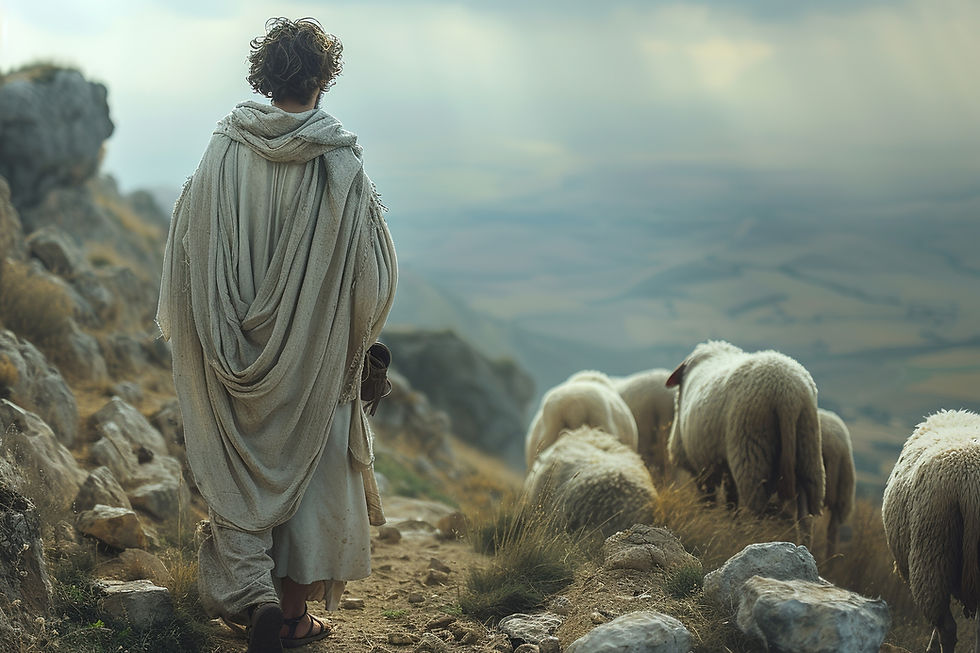
“He chose David also his servant,
and took him from the sheepfolds:
From following the ewes great with young
He brought him to feed Jacob his people,
and Israel his inheritance.”
(Psalm 78:70–71)
God trained David in obscurity—courage, watchfulness, faithfulness—long before the crown. When David later stood before Saul, he described how shepherding had shaped him:
“Thy servant kept his father’s sheep,
and there came a lion, and a bear…
and I went out after him, and smote him.”
(1 Samuel 17:34–35)
This matters because Scripture promises that the Messiah would come from David’s line:
“There shall come forth a rod
out of the stem of Jesse.”
(Isaiah 11:1)

And that He would be born in Bethlehem—David’s city (Micah 5:2)—is no coincidence.
"But thou, Bethlehem Ephratah,
though thou be little among the thousands of Judah,
yet out of thee shall he come forth unto me that is to be ruler in Israel;
whose goings forth have been from of old, from everlasting."
Jesus calls Himself the Good Shepherd

Centuries later, Jesus draws directly from this imagery:
“I am the good shepherd:
the good shepherd giveth his life for the sheep.”(John 10:11)
Jesus contrasts Himself with the hired hand:
“The hireling fleeth,
because he is an hireling,
and careth not for the sheep.”(John 10:13)
A word about false shepherds
Scripture is clear that not all shepherds are faithful ones. God sharply condemns false shepherds—leaders who feed themselves rather than the flock, who neglect the weak and scatter the sheep (Ezekiel 34:2–5). But He also makes a promise: “I myself will search for my sheep and look after them” (Ezekiel 34:11), and “I will place over them one shepherd… my servant David” (Ezekiel 34:23).
When Jesus later declares, “I am the good shepherd. The good shepherd lays down his life for the sheep” (John 10:11), He is revealing Himself as the fulfillment of that promise. It is fitting, then, that God announces the birth of the Good Shepherd first to men who know what true shepherding costs.

Why Might God Tell the Shepherds First?
Luke does not explain explicitly, but Scripture gives us the pattern:
“He hath put down the mighty from their seats,
and exalted them of low degree.”
(Luke 1:52)
“God hath chosen the foolish things of the world
to confound the wise.”
(1 Corinthians 1:27)
The shepherds represent the humble of Israel. Yesterday we saw that the Magi represent the Gentile nations (Matthew 2:1–2). Together, they proclaim that this Child is for all people:
“Which shall be to all people.”(Luke 2:10)
The Angels

What are angels? Angels are created spiritual beings who serve God:
“Bless the LORD, ye his angels, that excel in strength,
that do his commandments,
hearkening unto the voice of his word.”
(Psalm 103:20)
They are not human, not divine, and not symbolic. They are God’s servants and messengers.
When were angels created?
While Scripture does not give a precise moment, angels were present when God laid earth’s foundations:
“When the morning stars sang together,
and all the sons of God shouted for joy.”(Job 38:7)

Notable "Good" Angels in Scripture
Gabriel appears as a messenger of major redemptive events (Daniel 8:16; Luke 1:19, 26).
Michael is associated with spiritual conflict and Israel’s protection (Daniel 10:13, 21; Daniel 12:1; Jude 1:9).
(I say "good" angels, because Satan and the demons are "fallen" angels, but we're not talking about them today!)
Prominent appearances of angels
Angels appear at pivotal moments:
Jacob’s dream of heaven and earth connected (Genesis 28:12)
Strengthening God’s servants (1 Kings 19:5–7; Matthew 4:11)
Present at moments of martyrdom and glory (Acts 7:55–56)
Who was the angel who appeared to the shepherds?
Luke writes:
“And, lo, the angel of the Lord came upon them,
and the glory of the Lord shone round about them.”(Luke 2:9)
The angel is unnamed here. I tend to think it was Gabriel, since Gabriel is the angel that spoke to Mary, but the focus is not his identity; rather, the message and the glory of God that accompanies it.
Popular Misconceptions About Angels

People do not become angels when they die.
Humans and angels are distinct creations (Hebrews 2:16; 1 Corinthians 15:42–44).
Angels are not blonde women or cute children; they are consistently described using masculine pronouns when they appear visibly (Daniel 9:21; Luke 1:26).
Scripture always has angels speaking, proclaiming; they are never said to "sing"
“Praising God, and saying…”(Luke 2:13)
Revelation clearly shows singing in heaven, but it is the redeemed who sing — particularly “new songs” rooted in redemption. Angels proclaim, declare, and praise God, but Scripture reserves singing as a distinctive expression of redeemed humanity. How wonderful is that? We are the ones that get to SING!!!!!!!!!!!!!!!!!!!!!!!!!
(At the end of this post , I feature the traditional carol "It Came Upon a Midnight Clear," however, where the angels are clearly described as singing! Oh well, I'll have to make that brief allowance for the sake of tradition! 😇)

What do angels do today?
Scripture teaches that angels:
Serve as messengers (Hebrews 1:14)
Minister on behalf of God’s people (Psalm 91:11)
Participate in God’s present and future purposes (Matthew 25:31; Revelation 5:11)
Yes, apparently they are busy serving us!
Wow. How mysterious and intriguing, right? 😮
Yet angels never draw attention to themselves—they always point to God.

Twice in Revelation, when John falls at the feet of an angel in awe, the angel immediately stops him, saying,
“See thou do it not… worship God”
(Revelation 19:10; 22:8–9).
The angel identifies himself simply as a fellow servant, not an object of reverence, and redirects all honor back to the LORD.
This reinforces an important biblical truth: angels never exist to draw attention to themselves. Their role is to serve God’s purposes and to point unwaveringly toward Him alone. And… we never address angels in prayer - don't ask your "Guardian Angel" for anything; if you have one, it will move in your life at the beck and call of God. 😇
When Shepherds & Angels Meet – Heaven Collides with Earth in a Starry Sky!
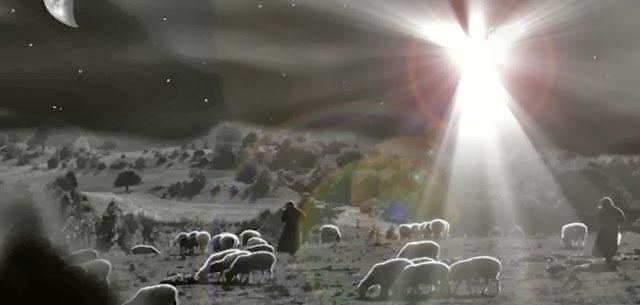
The Message: Absolutely No Ambiguity Here!
Remember, the shepherds, at this point, are, understandably,
"SORE AFRAID!"
“Fear not: for, behold,
I bring you good tidings of great joy…
For unto you is born this day
in the city of David a Saviour,
which is Christ the Lord.”
(Luke 2:10–11)
This is the long-awaited Christ - the Messiah - Emmanuel - God with Us!
But the sign is one of astonishing humility:
“Ye shall find the babe
wrapped in swaddling clothes,
lying in a manger.”
(Luke 2:12)

The Messiah is revealed not in splendor, but in humility:
“Though he was rich,
yet for your sakes he became poor.”
(2 Corinthians 8:9)
Then, the heavenly host make a very quick appearance!
“And suddenly there was with the angel
a multitude of the heavenly host praising God and saying.
Glory to God in the highest, and on earth,
peace among men with whom He is pleased...”
(Luke 2:13)
Then they simply vanish —as suddenly as they appeared —and the field is quiet again.
The shepherds respond:
“'Let us now go even unto Bethlehem'…
And they came with haste.”
(Luke 2:15–16)

They find everything exactly as God said it would be.
“For no word from God
shall be void of power.”
(Luke 1:37)
And then? The shepherds become the first "evangelists:"
“And when they had seen it,
they made known abroad the saying
which was told them concerning this child.”
(Luke 2:17)
They were the first to hear, and they became the first to tell.
Closing Thoughts

The shepherds show us that when God gives light, the right response is not merely admiration—but movement and testimony:
"Go, Tell it on the Mountain,
that Jesus Christ is Born!" ♪♫♪
And the angels remind us that Jesus Christ is the ONE grand theme of heaven! The angels’ song does not end with glory alone. It moves deliberately from heaven to earth:
“Glory to God in the highest,
and on earth peace,
good will toward men,
with whom He is pleased.”
(Luke 2:14)

FAQ
Q: How do I know if I am one with whom He is pleased?
A: By having believing faith in Him:
“But without faith it is impossible to please him:
for he that cometh to God must believe that He is,
and that He is a rewarder
of them that diligently seek Him.”
Hebrews 11:6
Further, this peace is not a vague feeling or a seasonal sentiment. It is not merely inner calm or the absence of conflict. It is something far more profound. It is a contracted peace treaty, if you will:

Peace made between God and man. Scripture tells us plainly that humanity was not at peace with God by default. Sin brought separation. Walls were raised—between God and man, between Jew and Gentile, between heaven and earth. But the Child lying in the manger came with a purpose far greater than comfort or inspiration.
“For He is our peace.”
(Ephesians 2:14)
The angels announced peace that night because peace had arrived in flesh and blood. God was no longer sending messages by messengers only—He had come Himself.
Immanuel. God with us. Jesus Christ. The Savior of the world.
"And the Word became flesh and dwelt among us,
and we beheld His glory,
glory as of the only begotten
from the Father,
full of grace and truth."
John 1:14
And that peace - once proclaimed in the fields outside Bethlehem to a gathering of unsuspecting shepherds - sealed by "His own body on a tree" (1 Peter 2:24), now stands open to all who receive Him.
"But as many received Him, to them gave He
the right to become children of God,
even to those who believe in His name..."
John 1:12
It Came Upon the Midnight Clear
Lyrics by Edmund Hamilton Sears (1849)
It came upon the midnight clear,
That glorious song of old,
From angels bending near the earth
To touch their harps of gold:
“Peace on the earth, good will to men,
From heaven’s all-gracious King.”
The world in solemn stillness lay
To hear the angels sing.
Still through the cloven skies they come
With peaceful wings unfurled,
And still their heavenly music floats
O’er all the weary world;
Above its sad and lowly plains
They bend on hovering wing,
And ever o’er its Babel sounds
The blessed angels sing.
Yet with the woes of sin and strife
The world has suffered long;
Beneath the angel strain have rolled
Two thousand years of wrong;
And man, at war with man, hears not
The love-song which they bring;
O hush the noise, ye men of strife,
And hear the angels sing!
For lo! the days are hastening on,
By prophet bards foretold,
When with the ever-circling years
Shall come the time foretold,
When peace shall over all the earth
Its ancient splendors fling,
And the whole world send back the song
Which now the angels sing!

*Interested in knowing how to enter into a personal relationship with God through faith in the death and resurrection of Jesus Christ? Say a Salvation Prayer and Receive Jesus Christ Today.
Of course, the saying of a prayer is the reflection of a monumental and life-changing heart decision, but this is a good guide.


Absolutely loved this one ! Thank you & Merry Christmas!